Important
The diversification of OR’s business operations is a crucial aspect where OR increasingly emphasizes occupational health and safety to align with business appropriateness. This is to instill confidence in being a safe and secure workplace for employees, suppliers, on-site workers (contractors), partners, as well as the neighboring communities close to OR operating sites. Recognizing that occupational health and safety is a fundamental right for employees, suppliers, on-site workers (contractors), partners, and communities around OR operating sites, OR adheres to policies, guidelines, and safety and occupational health management practices in line with Thailand’s national practices and international standards. This encompasses processes from production to transportation, all the way to the distribution of goods and services, covering both the Mobility and Lifestyle business unit.
2023 Targets

Management Approach
As part of the OR 2030 Goals, Health & Safety is identified as a key objective to elevate the quality of life and well-being of both the business area and the surrounding community.
Therefore, OR has implemented more stringent safety measures, including activities to raise safety awareness among employees and contractors. The aim is to ensure the highest level of safety for both employees and contractors while working with OR.
Quality, Security, Safety, Health, and Environment Policy (QSHE Policy)
OHS Management System Governance Structure
The Sustainability, Quality, Safety, Health and Environment Department (QSHE Department) is the unit responsible for overseeing health and safety operations. The division establishes policies and projects to communicate and ensure operational alignment with these policies, receiving support from designated individuals within each business unit, such as professional safety officers in the petroleum terminals
To ensure the organization achieves its safety and health management goals, OR designates Operational Safety as a Corporate Key Performance Indicator (KPI). This KPI influences performance appraisals and is a shared responsibility among all employees. QSHE Department quarterly presents OHS operational performance results to the QSHE Management Committee (OR QSHE GMC) meeting, chaired by the Chief Executive Officer. This process aims to provide guidelines for continuous improvement in safety operations.
OHS Management System and Programs
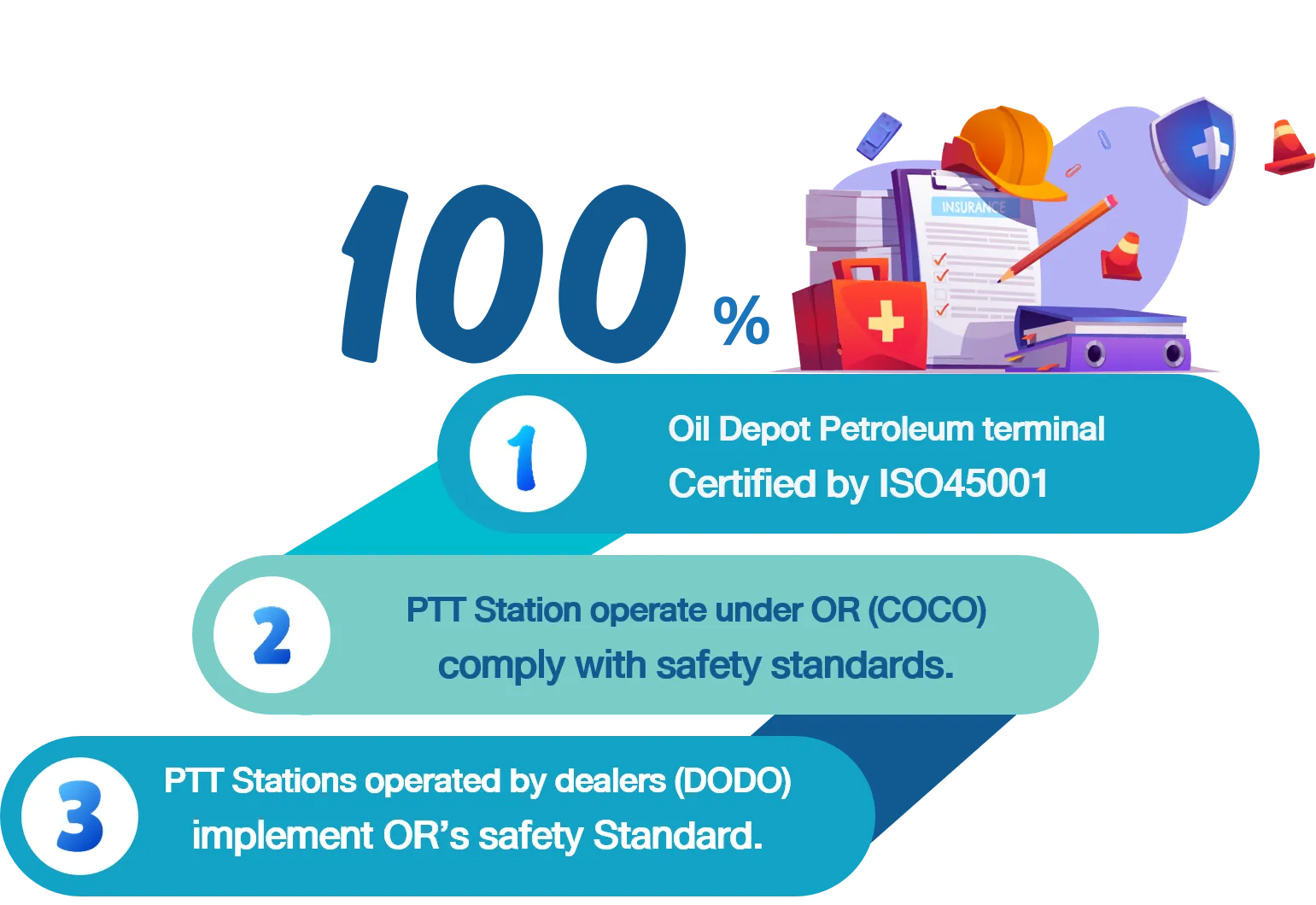
OR applies the Occupational Health and Safety Management System standard (ISO 45001) to all warehouse facilities operated directly by the company (Own Operation). In 2023, operations expanded to include a gas cylinder repair shop (Energy Solution Business). Furthermore, specific standards are established for each business area, such as transportation safety practices and safety standards for service stations, tailored to suit the operations of distributors and franchisees. The company promotes the development of suppliers’ management systems by conducting regular efficiency reviews for each operational area, both internally and externally, fostering continuous improvement.
Furthermore, OR has implemented the Process Safety Management (PSM) system in the Eastern region petroleum terminal, in collaboration with PTT and the gas cylinder painting workshop in Songkhla province. The Company also provides PSM training to employees in various areas to ensure the safety of operations and business activities.
OR has developed a system related to safety practices, namely the Work Permit System. This is an online system used to request permission to work in OR’s areas, ensuring comprehensive compliance with legal requirements and systematic data storage.
Furthermore, OR has implemented the e-MoC system, which stands for Management of Change. This system is designed to systematically manage internal changes within the petroleum warehouse operational unit. It ensures that the level of risk is within acceptable criteria and can be effectively managed.
Regarding to the OHS management for suppliers and contractors, OR integrated ESG which include OHS criteria in procurement and contractual requirements to ensure the effectiveness of OHS practices and reduce OHS risk from suppliers and contractors works. Please see details in ‘Supply Chain Management’ Website.
Risk and Hazard Assessments
OR conducts occupational health and safety risk assessments by considering both internal and external issues, as well as requirements of stakeholders. This assessment is mandated at least once a year for all facilities. In case of process changes, OR reviews operational procedures and related risks. The Sustainability, Quality, Safety, Health and Environment Department (QSHE) has established procedures for safety risk assessments and safety risk management, as follows:
Procedures of Safety Risk Assessment and Safety Risk Management
1. Activity or work process categorization: Consider tasks from the initial process to the final step of the operation to create a list of activities or steps in the workflow.
2. Hazard Identification and Risk Assessment: Utilize the list of activities or steps obtained from item 1 to specify hazards that may occur using methods appropriate to each activity and workflow step. Additionally, conduct a risk assessment based on the relevant criteria for each business.
3. Safety Risk Management Plan Development: Develop a risk management plan based on the results of the risk assessment, considering the following:
- Unacceptable Risk Level: Develop a plan to reduce or mitigate the risk by considering the implementation of control measures based on the Hierarchy of Control. Ensure that the risk is brought down to an acceptable level, and continuously monitor and control the effectiveness of the added measures.
- Acceptable Risk Level: Develop a plan for controlling the risk by maintaining the effectiveness of existing control measures.
4. Communication, Review, and Monitoring of the Effectiveness of Safety Risk Assessment and Management
Health Risk Assessment and Health Program
OR places importance on managing the health of its employees, especially given the increasing incidence of sudden illnesses. The company has established Medical Emergency Management as a guideline to handle medical emergencies, aiming to minimize the risk of fatalities or injuries among employees, as well as define effective recovery strategies for optimal rehabilitation.
Safety Culture and Health at Work
In 2023, OR has initiated the activity “The More We Discover, the Safer We Are” to enhance and orimite a safety culture among employees ins all departments. This involves conducting a competition for collaborative risk assessment in the workplace or operational areas. The goal is to reinforce OR as an organization with zero accidents. Employees are required to write reports on actions and situations below the required standards in their work, including reports on solutions, with at least one submission per person. These reports are submitted through the Incident/Sub-Standard Report System on the OR Intranet. The reports are then analyzed, and solutions and preventive measures are developed to prevent reoccurrence. Employee Participation in Occupational, Health and Safety This serves as a Corporate KPI for assessing the performance of management, employees, and those involved in the management of occupational health issues organization-wide.
Health and Safety Training for Employees
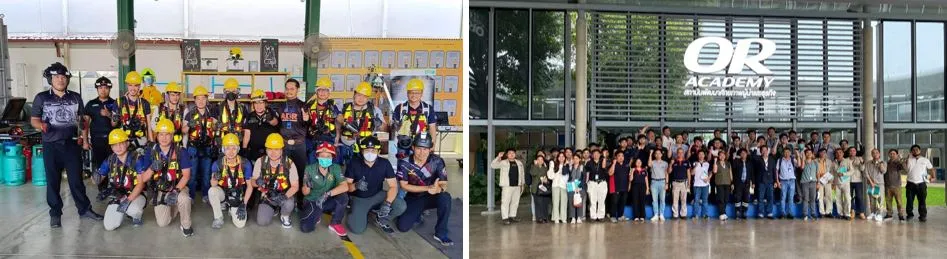
OR has established annual safety training requirements essential for operations to achieve the Zero Accident goal. The training encompasses topics related to safety, such as high-risk work, first aid and CPR, safe driving practices, advanced firefighting, the use of the Lockout-Tagout system, and the permit-to-work system. Additionally, it includes training on hazard identification and risk assessment, utilizing Hazard and Operability Study (HAZOP) and Layer of Protection Analysis (LOPA) methodologies. Training also extends to building awareness regarding safety and security at service stations and retail outlets.
The content of training related to occupational health includes the assessment of health risks, basic knowledge of ergonomics, muscle exercise to reduce fatigue from work, modifying work-age behavior to reduce the risk of chronic diseases (NCDs), muscle exercise to reduce fatigue from work, and fostering motivation for behavior change in regards to exercise. This foundational knowledge in occupational health is designed for safety officers and operational personnel, among others.

OHS Management System Performance Review
This includes performance review results aimed at reducing health and safety risks for employees according to the established goals.
Safety System in Transportation
For safety measures in maritime transport, vessels transporting petroleum products to OR must undergo the assessment process by the PTT Group, which consists of the following steps:
- Vessel inspection conducted by inspectors certified by OCIMF (Oil Companies International Marine Forum).
- Vessel Vetting by PTT Group Marine Expertise, which utilizes results from vessel inspections against Marine Environmental and Safety Criteria. The entire process of the vessel vetting system is recorded in the Web Marine Quality Assurance Program.
Furthermore, in evaluating the performance of the marine transportation of petroleum products, OR incorporates the Tanker Management and Self-Assessment (TMSA) tool from OCIMF as part of the assessment of suppliers. The objective is to enhance safety in the maritime transportation of petroleum products and elevate the operational standards of OR’s maritime transport suppliers to international standards.
Performance
As a result of continuous efforts in the field of occupational health and safety, OR achieved a reduction in the accident rate in 2023 compared to 2022.
Projects that OR has implemented to promote employee health are as follows.

Happy Workplace Project
To promote improvements in the working environment in accordance with ergonomic principles.
Health Me Please Project
To provide knowledge to raise awareness among employees to monitor diseases that are currently prevalent or receive health warnings from the government.
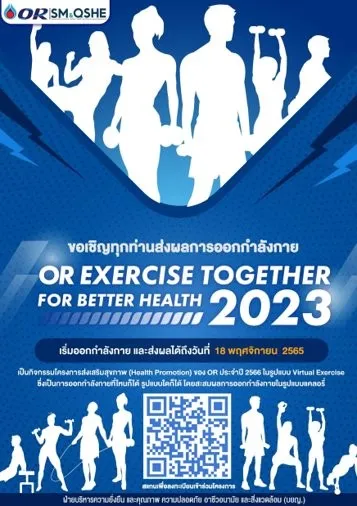
OR Exercise Together for Better Health Project
To promote awareness among employees about taking preventive measures for their health.
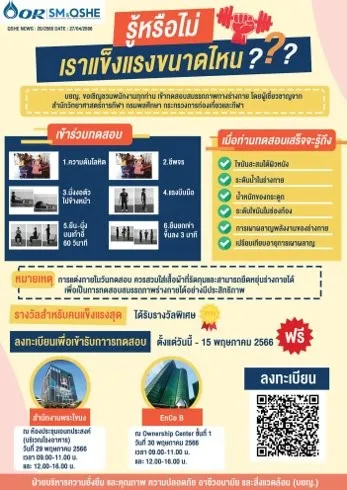
Know Your Strength Project
To assess the body's capabilities and receive consultations from experts on monitoring, preventing, and promoting better health.

OR RUN 2023
To promote employees to engage in physical exercise for good health.
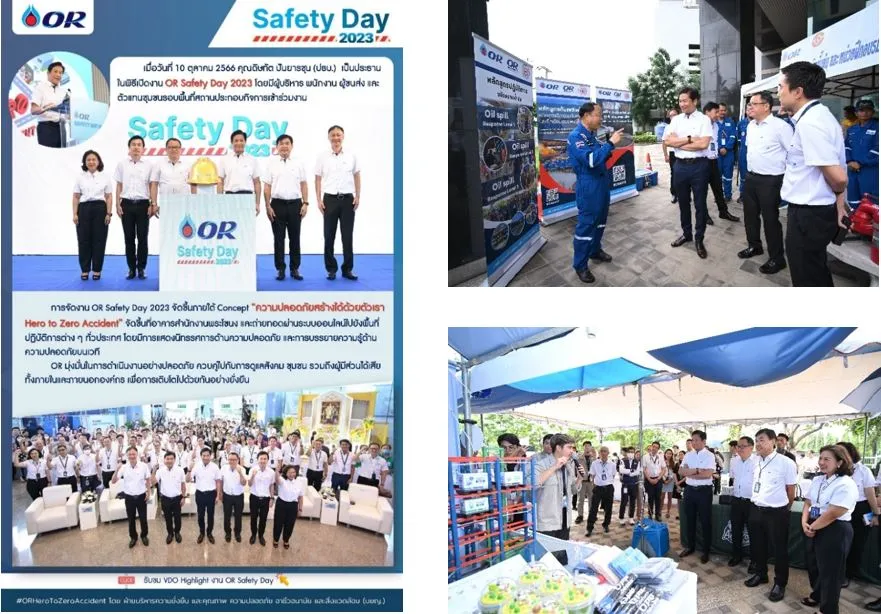
The commitment towards becoming a Zero Accident organization is the driving force for OR to conceptualize projects and activities that strengthen the organization’s occupational health and safety. This has led to the initiation of the Safety Day event, aimed at promoting safety awareness. In 2023, the event took place on October 10th, at the Phra Khanong office, and was broadcasted online to various operational areas nationwide under the concept “Safety is Achievable – Hero to Zero Accident.” The event saw the participation of executives, employees, transporters, and community representatives around the operational areas. The objective was to raise awareness regarding safety, occupational health, and the environment in the workplace. It aimed to instill knowledge and understanding of safety among employees and contractors, promoting safety participation for everyone to contribute to the organization’s safety drive. The event emphasized the importance of campaigning to reduce accidents. In addition, each operational unit organized internal safety campaigns to communicate policies and operational directions related to safety within the unit to raise awareness and promote safety within the unit, encouraging everyone to participate in driving the safety culture of the organization and recognizing the importance of advocating accident reduction.