Managing impacts on stakeholders in the OR value chain
OR Value Chain
The structure of the business operations is divided into 4 main groups, namely the Mobility business, Lifestyle business, Global Business, and Innovation business. Key activities in the Mobility business include the distribution of petroleum products through retail markets, energy solutions, and lubricant business. The main products include gasoline, diesel, liquefied petroleum gas (LPG), aviation fuel, Marine fuel oil and industrial sectors, and lubricants. As for the Lifestyles business such as coffee shops, convenience stores, retail outlets, food and beverage businesses, as well as area management businesses in PTT Stations. The Global business group operates both Mobility and Lifestyles business through subsidiary companies established abroad. Additionally, OR has established ORZON Venture, to seek investment opportunities in start-up companies focusing on Mobility and Lifestyles, both domestically and internationally. Furthermore, there are support units such as OR Academy, Lifestyle Business Center (OASYS), Financial Structure, Digital Technology Structure, and People and Organizational Structure. Each activity is related to OR’s six main stakeholders as follows.
OR Value Chain | Main stakeholders and their involvement with the activity |
|---|---|
![]() Procurement (Sourcing Raw Material) | • Country: Government agencies responsible for policymaking and oversight, as well as those with roles in supervision, approval, and authorization
• Shareholders/Investors: Shareholders, investors, juristic persons, and institutions investing in the stock market • Business Partners and Suppliers: Suppliers of products and services • Society and Communities: Individuals who may be affected by the raw material procurement process. |
![]() Transportation | • Country: Government agencies, policy makers, and those responsible for corporate governance, approval, and authorization
• Business Partners and Suppliers: Suppliers of products and services • Society and Communities: Individuals who may be affected by transportation. |
![]() Production and service | • Country: Government agencies, policy makers, and those responsible for corporate governance, approval, and authorization.
• Shareholders/Investors: Shareholders, investors, juristic persons, and institutions investing in the stock market • Employees: OR employees and employees hired through outside companies under OR’s supervision. • Business Partners and Suppliers: Suppliers of products and services • Society and Communities: Individuals who may be affected by business operations. |

![]() Delivery of goods and services | • Country: Government agencies, policy makers, and those responsible for corporate governance, approval, and authorization
• Shareholders/Investors: Shareholders, investors, legal entities, and institutions that invest in the stock market. • Business Partners and Suppliers: Suppliers of products and services • Customers: Distributors, those who hold the right to operate business, and consumers • Society and Communities: Individuals who may be affected by the delivery of goods and services. |
![]() Joint investment | • Country: Government agencies, policy makers, and those responsible for corporate governance, approval, and authorization.
• Shareholders/Investors: Shareholders, investors, legal entities, and institutions that invest in the stock market. • Business Partners and Suppliers: Joint venture companies, business partners • Customers: Distributors, business license holders, and consumers • Society and Communities: Individuals who may be affected by business operations. |
![]() Support activities* | • Country: Government agencies, policy makers, and those responsible for corporate governance, approval, and authorization.
• Shareholders/Investors: Shareholders, investors, legal entities, and institutions that invest in the stock market. • Employees: OR employees and employees hired through outside companies under OR’s supervision. • Business Partners and Suppliers: Joint venture companies, business partners, supplier of goods and services, and contractors • Customers: Distributors, those who hold the right to operate business, and consumers • Society and Community: Individuals who may be affected by business operations. |
OR value chain and scope of operations

Note:
1 LPG gas from the PTT gas separation plant is transported through pipelines to the Khao Bo Ya LPG Gas Terminal and the Ban Rong Po LPG Terminal before further transportation by trucks, ships, and trains to the destination warehouses. The majority of LPG gas comes from gas separation plants, but additional LPG gas is also taken from oil refineries.
2 Cooking gas tanks of all sizes, if their legal testing period expires or if they are damaged, shall be sent back to the liquefied petroleum gas storage. They will then be forwarded to the OR refurbishing plant for testing, repair, and refurbishment of the tank’s condition, color, and screen printing on the tank to be completed before they are returned for refilling with gas for resale again.
Stakeholder Engagement
OR engages with stakeholders in each group, varying based on the appropriateness of opportunities and the level of the relationship, both formally and informally. This is to collaboratively drive positive changes and minimize negative impacts for all parties involved. The guidelines for engaging with stakeholders include:
- Identifying and prioritizing the importance of stakeholders
- Developing strategies for engaging with stakeholders
- Planning and implementing stakeholder engagement activities, along with data collection for reporting
- Executing stakeholder engagement plans
- Monitoring the outcomes of engagement activities, such as conducting feedback surveys and addressing arising issues
From the sustainability management policy that emphasizes maintaining a balance in economic, social, and environmental aspects, as well as all groups of stakeholders, for the sustainability of the business, OR has developed the Stakeholder Engagement Guideline, which outlines effective ways to engage with stakeholders, referencing the AA1000 Stakeholder Engagement Standard by Accountability. Each department is responsible for identifying and prioritizing the importance of stakeholders related to its operations and engaging with them. The engagement strategies vary based on the prioritization and concerns/expectations of stakeholder groups. The stakeholder engagement data is then summarized for the sustainability Quality, Security, Safety, Health and Environment department. The outcomes of the stakeholder engagement can be summarized as follows:
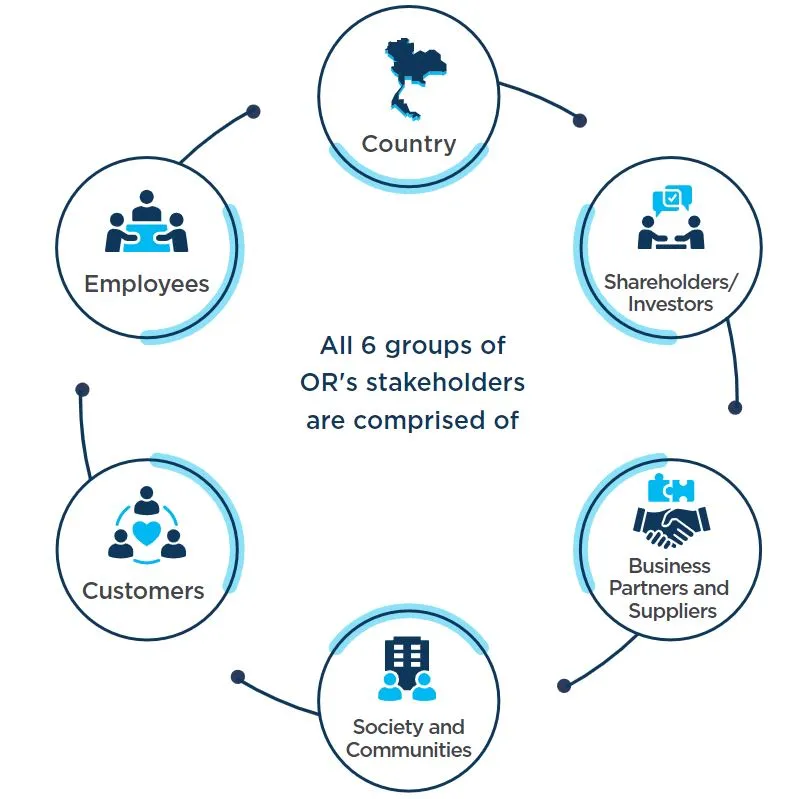
OR’s main stakeholders are divided into 6 groups, consisting of:
Results of Feedback from Key Stakeholders
Country | ||
|---|---|---|
Participation approach | Concerns and Expectations | Approaches to address concerns or expectations |
• Seminars and meetings according to the agenda
• Preparing reports on the progress of work or relevant documents to be submitted to government agencies in accordance with the law • Supporting and cooperating | • Compliance with laws, regulations, and responsiveness to government policies | • Strict adherence to the law
• Incorporating government policies into business strategies and directions • Communicating legal implementations to stakeholders • Setting a good example for other businesses |
Shareholders/Investors | ||
|---|---|---|
Participation approach | Concerns and Expectations | Approaches to address concerns or expectations |
• Meetings
• Disclosure of information through annual reports • Channels for receiving feedback, suggestions, and complaints through the Ordering & Customer Relations Center 1365, and the website | • Corporate governance
• Sustained business growth and worthwhile returns • Business adaptation to challenges, fluctuations, and changing circumstances | • Compliance with corporate governance policies
• Communicating and disclosing business operation information to stakeholders • Publishing One Report (Form 56-1) and the sustainability report • Incorporating ESG principles into the organization’s strategy and objectives |
Business Partners and Suppliers | ||
|---|---|---|
Participation approach | Concerns and Expectations | Approaches to address concerns or expectations |
• Meetings, seminars, and appointments
• Providing knowledge through training • Channels for receiving feedback, suggestions, and complaints • Business Partners and Suppliers satisfaction assessment | • Conducting business smoothly and fairly, with standards and clear criteria for conducting business with Business Partners and Suppliers
• Developing the capacity of Business Partners and Suppliers in both business aspects and sustainable business practices | • Having business processes that are transparent, fair, and equal for Business Partners and Suppliers, along with clear criteria for selecting suppliers based on policies and practices related to corporate governance
• Providing training to enhance knowledge for Business Partners and Suppliers |
Society and communities | ||
|---|---|---|
Participation approach | Concerns and Expectations | Approaches to address concerns or expectations |
• Community satisfaction assessment
• Channels for receiving feedback, suggestions, and complaints through the Ordering & Customer Relations Center 1365, and the website • On-site engagement for exchanging ideas • Creating Shared Value (CSV) • Communication of information and facts | • Community development, promoting community businesses, creating jobs and income, and improving the environment
• Reducing social inequalities, including physical disabilities, income levels, vulnerable groups, and gender or age differences • Conducting businesses that do not adversely affect the community, including providing channels for communication, coordination, and rapid problem-solving • Communicating information and facts quickly, accurately, and comprehensively | • Promoting business models that foster community involvement, including participating in community development and enhancing community livelihoods and local economy through Creating Shared Value (CSV)
• Promoting social equality through Café Amazon for Chance outlets, providing opportunities for socially disadvantaged individuals to develop themselves into baristas or staff • Controlling operations with management standards that do not adversely affect the community Monitoring and continuously improving operations. • Providing channels for coordination and rapid problem-solving • Communicating and publicizing information, news, and facts quickly, accurately, and comprehensively, and adhering to ethical standards in advertising products and services |
Customers | ||
|---|---|---|
Participation approach | Concerns and Expectations | Approaches to address concerns or expectations |
• Organizing seminars and roadshows
• Contacting customers • Satisfaction surveys • Service and assistance • Channels for receiving feedback, suggestions, and complaints through Ordering & Customer Relations Center 1365 | • Delivering quality products and services according to standards and safety
• Managing issues that pose risks to customer confidence and building a positive reputation for OR | • Developing innovations to enhance the level of delivery and customer service across various aspects comprehensively
• Quality Assurance (QA) processes and coaching to control the service quality of employees • Listening to customer feedback and undertaking improvements, developments, and improvements of products and services to meet their needs |
Employees | ||
|---|---|---|
Participation approach | Issues of concern and expectations | Guidelines for mitigating action in response to concerns or expectations |
• Developing knowledge, skills, expertise, and experience
• Communicating information and listening to feedback through various communication channels • Organizing activities to build relationships among employees • Conducting an Employee Engagement Survey and assessing adherence to the organizational culture (OR DNA) | • Employees have the knowledge and expertise to conduct business and are sufficiently staffed to support business operations
• Providing guidance and opportunities for employee growth and career advancement • Cultivating employee pride in the organization and readiness to grow sustainably with the organization • Providing benefits that meet employees’ needs • Providing a conducive work environment | • Developing employees’ knowledge, skills, and experience for their expertise to be aligned with the organization’s strategic direction
• Cultivating OR DNA within the Company’s culture to empower employees and foster collective success • Adapting work practices to utilize technology, workspace optimization, equipment upgrades, and redesigning work processes • Providing benefits that meet employees’ needs • Assessing the work environment and conducting health assessments for employees working in high-risk areas |
In addition, OR regularly reports on the outcomes of its corporate engagement activities with all stakeholders to the OR Sustainable Development Committee (OR SD Committee) quarterly. The objective is to discuss and propose improvement guidelines for implementing a more effective engagement with all stakeholders.