


- Home
- >
- Sustainability
- >
- Highlight: Community Development and Social Collaboration
Highlight: Community Development and Social Collaboration
Driving the Business

For OR, society and communities constitute an important stakeholder group that OR takes seriously in regard to participatory social and community development as reflected in the organization’s vision to fulfill the opportunity for shared growth. This commitment is one of the important pillars in OR’s SDG strategy under the “S – Small” pillar, which is to create opportunities for the small people through business conduct along with improving the quality of life of people in the community.
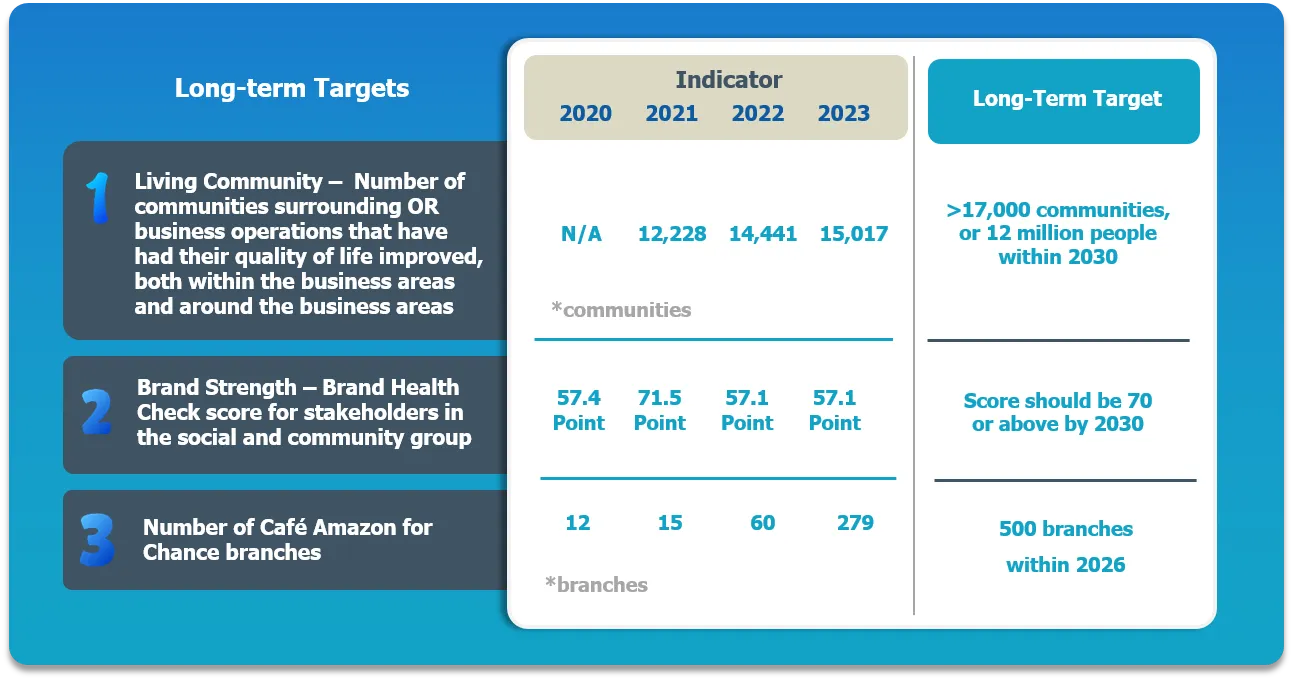
In order to drive the implementation of social and community development in a concrete and efficient manner, OR has established corporate performance indicators (corporate KPIs) that measure participatory social and community development performance which is also included as one of the indicators in the Executive KPI, with details as follow:
The Community Development and Social Collaboration is part of CEO and executive KPI, which is in the OR 2030 Goals – Living Community topic (5% of total weight). For more information on Social and Community Development strategies, see “Community and Social Development”
Challenges and Opportunities
If OR is unable to maintain the social license to operate, the Company may face challenges in the operation of its businesses, such as possible protests by communities around its operating areas, leading to business disruption, as well as challenges in attracting new employees, customers, and investors
Operation strategy
OR drives social project implementation with the CSR approach towards CSV by integrating the social and community development factor into corporate vision and strategy. This is to create projects that have a positive concurrent impact on society and business, such as the “Café Amazon for Chance” project, “Community Coffee Sourcing” project, and “Thai Det” project with the focus on achieving goals according to the OR SDG. OR has implemented a system to survey opinions and expectations of communities and society, in order to design projects with an emphasis on cooperation between the company and the community, and the effective utilization of the company’s resources, such as financial, or the expertise of the OR employees, to achieve the highest social score results. In addition, concrete measures have been taken to evaluate good operating practices that should be further expanded, including improvements that should be leveraged.
See additional information in the “Participatory Community and Social Development”
Long-Term Targets
Projects and Outstanding Achievements
OR is committed to driving projects for society that address the needs and concerns of stakeholders, implementing initiatives that provide equal opportunity for all to participate. Two exemplary social projects undertaken by OR, which were used as case studies in 2023, are the Community Coffee Sourcing (CCS) Project and the Thai Det project. The target groups include community enterprises and farmers with commercially viable local products. OR plays a significant role in strengthening community enterprises in various dimensions, such as increasing product value, marketing, raising product standards, and conducting socially and environmentally responsible business practices. These two projects have been providing over five years of impact assessment data. Therefore, to illustrate the outcomes and impacts of OR’s social projects, a social return on investment (SROI) assessment is necessary to evaluate changes in economic, social, and environmental dimensions in monetary terms. This assessment was conducted by consultants from Thammasat University Research and Consultancy Institute. Results for both case study projects are described below.
Community Coffee Sourcing Project (CCS)
About the project:
The Community Coffee Sourcing (CCS) project commenced in September 2017, with the signing of a memorandum of understanding (MOU) between Sarn Palang Social Enterprise Limited and farmer cooperatives on trade of parchment coffee from cultivation and production methods that support environmental conservation. The MOU sets out OR’s commitment to purchase coffee from farmers to use in coffee production at OR’s café Amazon stores. Participating farmers get to access additional benefits and various training courses tailored to their needs, covering coffee cultivation, maintenance, harvesting, and processing. Apart from enhancing the local farmers’ capabilities in coffee cultivation and sales, the CCS Project also provided an important alternative source of coffee beans for Café Amazon’s business. Currently, CCS project coffee beans constitute 10-15% of all coffee beans used by Café Amazon stores.
Presently, the CCS Project has 330 participants from 19 farmer groups, covering approximately 1,114 rais of coffee cultivation land. An estimated 400 Ton of coffee have been supplied to the Company. The social and environmental impacts and returns on investment from the CCS project indicate a net present value (NPV) of 60 million Baht and a social return on investment (SROI) index of 1.48. Considering only the business aspect, the economic impact, represented by NPV or net benefit, amounts to 26 Baht, with a return on investment (ROI) index of 1.21. This assessment demonstrates that OR’s investment in the CCS project has yielded significant social and environmental benefits.
Outputs:
- 19 farmer groups generated income by selling coffee to Sarn Palang Social Enterprise Limited.
- 896 farmers were trained on cultivation, maintenance, harvesting, and processing of coffee beans.
Outcomes: ESG Business Case SROI = 1.48 (Project data from 2017 – 2023)
- Coffee farmers have a stable market for their produce as a result of the MOU for coffee seed procurement between Sarn Palang Social Enterprise Limited and farmer groups, ensuring stable market access and income stability. Over the years, participating farmer groups have earned a total project income of 163 million baht.
- Community enterprises gained market bargaining power. The Baan Samsoong Coffee Producers have gained a 30% bargaining power for outside market, allowing them to sell coffee to middlemen at higher prices than those offered by Sarn Palang Social Enterprise Limited, at 15 baht per kilogram.
- Household expenses have been reduced through coffee cultivation alongside forest and fruit tree planting, enabling farmers to decrease expenditure on purchasing vegetables and fruits for consumption.
- Return migration to the community has occurred due to improved quality of life among farmer groups, leading to individuals returning to their communities from urban or external work to engage in local livelihoods, thereby reducing social issues stemming from family separation.
- Slash-and-burn agricultural practices have decreased as coffee cultivation has been promoted in the Baan Phalang community, with approximately 30% of total land transitioning from corn cultivation (which involves burning) to coffee cultivation, contributing to natural resource and environmental conservation in the area.
- Increased awareness of forest conservation has arisen from the coffee procurement process, with Sarn Palang Social Enterprise Limited providing additional benefits to farmers practicing natural resource and environmental conservation, as stipulated in the MOU regarding price differentials.
- The preservation of watershed forest ecosystems has been sustained as coffee farmers exhibit behaviors that conserve natural resources and the environment, ensuring the continued richness of ecosystem services in watershed areas.
- Reduced chemical usage in coffee cultivation is evident among coffee farmers in Baan Phalang, who have altered their cultivation practices to minimize chemical usage, resulting in improved environmental and ecosystem health in the area.
Benefit for stakeholders:
- Increased income stability for farmer groups
- Increased food security within communities
- Strengthened community cohesion and bonds
- Return migration to the community reduces social issues stemming from family separation, fostering peace and tranquility within the community
- Elevated quality of life, leading to sustainable community development.
- Increased capacity for sustainable agriculture amongst farmers
- Reduced forest fires and PM2.5 air pollution
- Sustainable use of the watershed forest ecosystem, biodiversity, and natural environment
Benefit for the Company:
- The Company created social enterprise business benefits by generating income from coffee bean sales throughout the project, totaling approximately 26 million baht (net benefit value as of the base year 2017).
Thai Det Project
About the project:
The “Thai Det” Project began in the year 2018, initiated by the collaboration of various governmental agencies with a shared commitment to support and drive the grassroots economy towards improving the quality of life, fostering robust and sustainable growth. Through enhancing the business capabilities of community enterprises/SMEs in production, marketing, and trade, OR plays a significant role by providing space within PTT Station and Café Amazon branches nationwide as distribution channels for community products, making it easier for community entrepreneurs nationwide to access markets and consumers. Simultaneously, this Project supports the business objectives of OR in branding PTT Stations and café Amazon stores, and enhancing customer satisfaction, making it a project that meets the business objectives of PTT Station and Café Amazon while developing the local economy.
Nonetheless, upon assessing the economic and social impacts of the project in the year 2023, it was found that the breakeven point has not yet been reached, due to the considerable investment in product promotion, which amounted to 40 million baht in the year 2023. The results from advertising necessitate a period of at least three years to generate awareness among consumers. Therefore, considering the economic and social impacts expected to occur in the next 3 years after product promotion, significant returns on investment will be realized.
Based on this study, recommendations for driving the project forward include a focus on creating opportunities for community enterprises and SMEs that are not yet strong in marketing. Collaboration and networking among entrepreneurs should be promoted, emphasizing product development and the importance of environmental impact in business operations.
Outputs:
- A total of 338 community enterprises/small and medium-sized enterprises (SMEs) participating in the project, including those with a variety of products in the categories of food, beverages, clothing, accessories, and household items.
Outcomes:
- Community enterprises/small and medium-sized enterprises (SMEs) have expanded their marketing channels for selling products, resulting in increased product sales. Revenue from selling products through the “Thailand Det” project amounts to 29.8 million baht.
- Revenue from product sales made through Thai Det stores/OR activities totals 15.1 million baht.
- Revenue from product sales made through Café Amazon stores amounts to 14.7 million baht.
- Improvements in product quality have been made towards standardized production systems, adding value to local raw materials and producing higher-value products.
- Expansion of production capacity has led to increased employment opportunities, such as hiring local community labor and elderly workers.
- There is an increase in purchasing local raw materials from the community.
- Expansion of the production group network to other communities or nearby areas.
- Consumers have easier access to local products, and there is a variety of products to choose from.
Benefit for stakeholders:
- Community enterprises/small and medium-sized enterprises (SMEs) have increased their income, resulting in income stability.
- Local products have been elevated to be widely recognized.
- Opportunities have been created to further promote local products.
- A local economic circulation system has been established in the community/society.
- Community cohesion has been fostered, strengthening the community.
- The quality of life in the community has been elevated, leading to sustainability in the community.
OR Plastic Blankets for Winter Warmth Project
About the project:
The OR Plastic Blankets for Winter Warmth Project was conceived from the recognition of an opportunity to use the strength and business assets of OR and PTT Global Chemical Company Limited (GC), which possessed expertise and resources to convert plastics for reuse to further benefit the society and the environment. This Project began with a campaign for employees of companies in the PTT Group, along with the public, to donate discarded plastic bottles at donation points located at 20 PTT Stations, as well as at donation points at the PTT offices and schools participating in the OR Plastic Blankets for Winter Warmth Project School Camp project, for a total of 26 locations. Upon receiving discarded plastic bottles, OR collaborated with GC to convert these bottles into fibers which are then forwarded to the community enterprises to weave into blankets. OR then donated the blankets to underprivileged people suffering from the cold weather in the Northern and Northeastern regions. This Project is considered to be beneficial all throughout the entire process of the operation – from instilling waste separation mindset in donors, to generating income for community enterprises weaving the blankets, to promoting a better quality of life for people suffering from the chilly weather, while at the same time reducing the plastic waste in the ecosystem.
Outcomes and benefits for stakeholders:
- Instilled waste separation and PET bottle recycling habits, with a total of 357,026 PET bottles received from donors (as of October 2023 / Project ended 30 November 2023)
- The community enterprise, with 63 members, earned a combined income of 3.26 million baht.
- Promoted the better quality of life for people affected by the chilly weather with the donation of 16,000 blankets
- Reduced plastic waste in the environment, equivalent to 7.1 tons of carbon dioxide equivalents in avoided GHG emissions.

OR encouraged Donations of used plastic bottles through disseminating posters within the Group and externally communications
and The Project was enthusiastically received with cooperation from many agencies, such as Thai Obayashi and Srinakharinwirot University.
Yak Lak Yim School Camp Project
Rationale
The world today considers the issue of climate change to be very important. Thailand is no exception. Many organizations, both public and private, have formulated policies that are not only concerned with the economic dimension, but also taking society, communities and the environment into serious consideration. PTT Oil and Retail Business Public Company Limited (OR), in addition to fostering growth in oil and retail business operations, has also formulated the vision and mission to conduct business while taking care of society, communities and the environment in a sustainable manner according to the organization’s OR 2030 Goals.
Project Objective
2.1 To instill behavior and awareness of appropriate waste management among youth who will form an essential catalyst for further development at the community, society and country levels.
2.2 To support the development of activities and systematic waste collection, and to use the reduction in the amount of greenhouse gas emissions as part of the efficiency measurement.
2.3 To promote participation with schools and communities in creating social innovation for sustainable environmental development.
Since the project was first implemented in 2022, OR has selected the first batch of schools and put into motion the development of their teachers and students. Since that first batch of schools, OR has expedited the project along with all the activities at 12 schools in nine provinces across the country. In 2023, OR opened applications for teachers to join the selection process in the second batch, with more than 1,000 schools all over the country applying to participate in the project. A total of 33 schools from four regions passed the selection criteria by the committee. They consisted of 10 schools from the Central region, 11 schools from the Northeastern region, six schools from the Southern region and six schools from the Northern region. The total number of participants from the first and second batches totalled 90 teachers.
In the first batch of schools that have passed the selection process with most concentrating on waste reduction policies and activities on educational platform, the top three awardees were:
- Winner: Ban Fon Witthaya Community School, Lampang Province
- 1st runner-up: Ban Bang Lamung School, Chonburi Province
- 2nd runner-up: Ban Kut Peng Community School, Ubon Ratchathani Province
In the second batch of schools with outstanding waste management processes, judged through the precise criteria for measuring the amount of greenhouse gas reduction from their activities together with creative and practical inventions, the top three awardees were:
- Winner: Ban Na Song Mueang School, Mukdahan Province
- 1st runner-up: Ban Huai Nok Kok School, Tak Province
- 2nd runner-up: Ban Dong Som School, Kamphaeng Phet Province
The winning schools and the 1st runners-up and 2nd runners-up from both batches, each received a plaque along with monetary prizes of 50,000 baht, 30,000 baht, and 20,000 baht, respectively. In addition, each of all 45 participating schools also received 10,000 baht funding for the respective project to be used for planning, and creating guidelines for waste management in schools. They also participated in seminars conducted by experts and experienced officials from the Department of Climate Change and Environment, Ministry of Natural Resources and Environment. Also, in 2024, they will be given the opportunity to submit their works as entries to the Low Emission Support Scheme (LESS) Award 2024 project with eligibility to receive a certificate of honor for helping to reduce, or to store, greenhouse gases through the evaluation from the Greenhouse Gas Management Organization (Public Organization).


